
How Carriers Calculate Fuel Surcharges, Where Costs Compound, and What You Can Negotiate
Introduction
Fuel surcharges are one of the most significant — and most misunderstood — line items on any freight invoice.
For parcel, LTL, truckload, air, and sea freight shipments, they are essentially universal: if freight moves, a fuel surcharge is applied. What is far less understood is how these charges are calculated, how they compound across accessorial fees, and what shippers can do to manage a negative impact on the bottom-line.
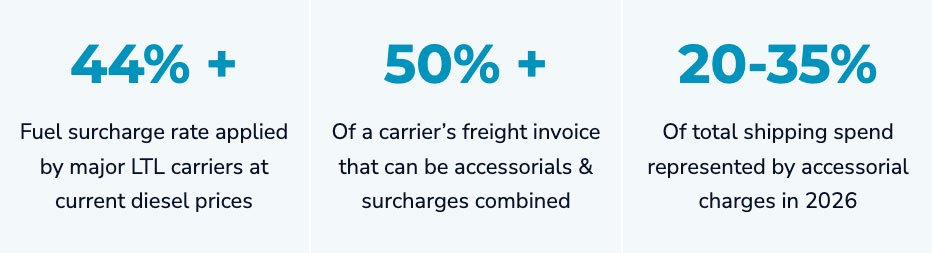
In 2026, rising diesel prices and significant carrier pricing changes have brought this conversation to the forefront. After years of relative fuel price stability, geopolitical disruption sent diesel prices surging in early 2026 — with the national average spiking nearly $1 per gallon in a single week in March, the largest single-week increase ever recorded.
Fuel surcharges, which are expressed as a percentage of the base freight charges, rose proportionally. For many shippers, the result was significant and largely unexplained invoice increases.
This article explains how fuel surcharges are calculated, where costs increase, what has changed in 2026, and why a structured review of your transportation program is a direct path to managing fuel charge exposure going forward.
The Current Environment
The U.S. Energy Information Administration (EIA) publishes a weekly national average on-highway diesel price, which serves as the primary benchmark for ground transportation fuel.
As of April 2026, the national average is $5.59 per gallon — up from roughly $3.90 just six weeks earlier. Regional prices in parts of the Northeast and West Coast are exceeding $6-$7 per gallon.
That increase was not gradual. In early March 2026, geopolitical escalation in the Middle East pushed Brent crude — the global oil pricing benchmark — above $120 per barrel. The U.S. national diesel average jumped nearly $1 per gallon in a single week — the largest one-week increase the EIA has ever recorded. The EIA now forecasts diesel averaging $4.80 per gallon for all of 2026, with April peaking above $5.80.
The EIA publishes weekly national and regional diesel prices every Monday at eia.gov/petroleum/gasdiesel
How Fuel Surcharges Are Calculated
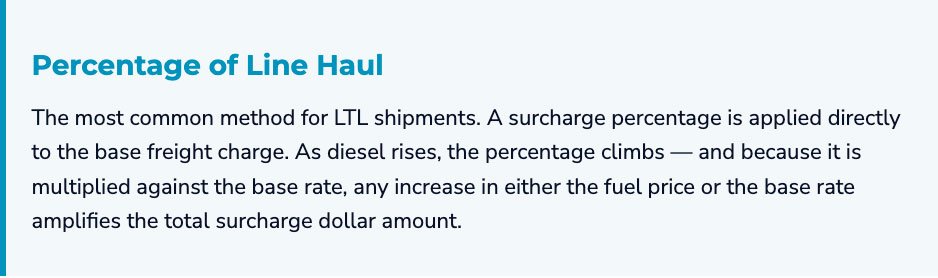
Carriers do not apply the EIA diesel price directly to a shipment. They use it to determine a surcharge percentage through a published table — a structured schedule that converts a diesel price range into a corresponding surcharge percentage applied to freight charges.
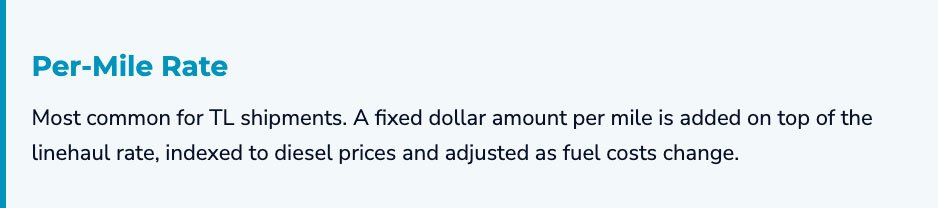
There are two primary calculation methods carriers use:
Using a standard surcharge table as an example, here is what the same $1,000 shipment costs at two different diesel price points:
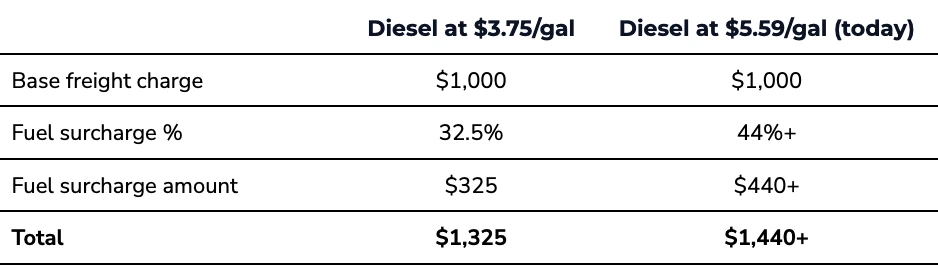
Same shipment. Same route. Same carrier. The only thing that changed was the price of diesel.
The Index is Updated Weekly — But the Table is Negotiable
What most shippers do not realize is that while the diesel index itself is not negotiable, the surcharge table applied to their account is. Carriers update their surcharge percentages weekly based on EIA data, but high-volume shippers can often secure a custom fuel surcharge table that is more favorable than the carrier’s publicly published one. This is one of the most direct and underutilized levers in transportation cost management.
Major carriers publish their current surcharge tables here:
LTL: Estes Express • XPO • Old Dominion • Saia • ABF Freight • R+L Carriers
Parcel: UPS • FedEx
Where Costs Compound and Why It Matters
Knowing the surcharge percentage still does not tell you the total fuel cost. The percentage only becomes meaningful when you know what it is being applied to. This is where most of the variation in freight invoices originates.
The Calculation Base: Gross or Net?
The discount and the surcharge calculation base are two separate terms in a carrier agreement. A shipper can negotiate a 40% discount and still have fuel surcharges applied to the published rate — not the discounted one — if the contract doesn’t specify otherwise.
Carriers don’t typically flag this during negotiation, and shippers rarely ask. Freight invoices show the surcharge amount but not the calculation behind it, which means shippers can overpay for years without realizing it.
Consider a shipment with a published transportation rate of $1,000 and a negotiated discount of 40%, producing a net cost of $600. The fuel surcharge for the week is 25%.
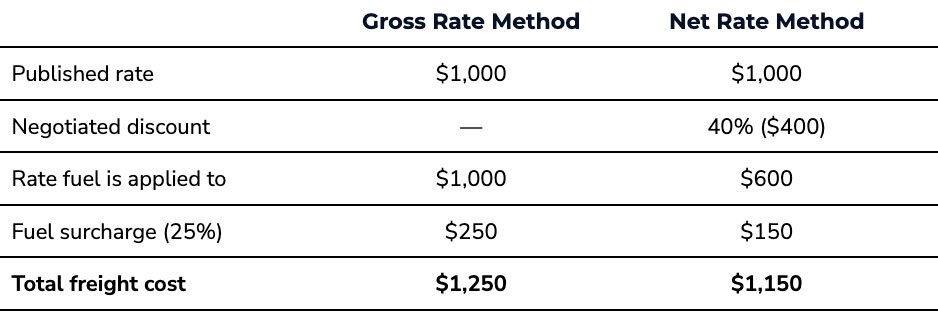
On a single shipment, that difference is only $100. But… across hundreds or thousands of shipments monthly or annually, it becomes a material and largely invisible cost — one that compounds every time diesel prices rise and surcharge percentages climb.
Fuel Surcharges Apply to Accessorial Fees Too
Fuel surcharges are not only applied to line haul charges. Depending on the carrier agreement, they may also apply to accessorial fees — residential delivery, liftgate, inside delivery, address correction, and more.
This is important because accessorial charges are one of the least visible and hardest to trace components of a freight invoice. They are often lumped together as a single line item, rarely broken out in a way that makes them easy to audit, and almost never scrutinized the way base rates are. Industry data indicates they now represent 20–35% of total shipping spend.
When fuel surcharges are applied automatically on top of accessorial fees (in accordance with contract language many shippers never review), the additional cost is significant and largely invisible.
For Finance and Accounting teams, these costs typically appear weeks after shipments have been delivered; as sudden or unexplained increases in LTL, invoices that do not align with expected rates, and additional time spent reconciling charges during close that should not require manual review.

Multiple Modes, Multiple Fuel Benchmarks
For shippers managing freight across multiple modes — and especially those with international volume — the EIA diesel price is only one of several fuel benchmarks affecting total transportation cost. Each is a separate commodity, priced in a separate market. A spike in U.S. diesel has no direct bearing on bunker fuel prices, and ocean fuel costs can rise or fall independent of anything happening at the domestic pump.
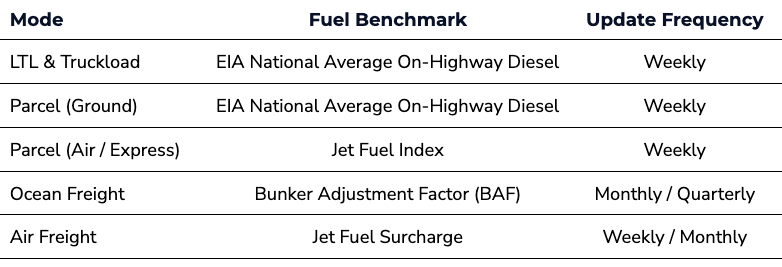
Of the modes in the table above, ocean freight is the most commonly misunderstood. That’s because ocean freight runs on an entirely different fuel. Ships burn bunker fuel, not diesel, and bunker prices are set by port and region, not by the EIA.
This means shippers with international volume need a completely different reference point to validate what they are being charged — Ship & Bunker publishes current bunker prices by port — the same data ocean carriers use to set their surcharges.
For any shipper managing freight across more than one mode, understanding which benchmark applies and how it is being used to calculate your surcharge is the starting point for managing the cost.
What Changed in 2026
Entering 2026, the consensus forecast was for lower fuel prices. The EIA projected a national average of approximately $3.50 per gallon — a continuation of the gradual downward trend from prior years. Carriers and shippers alike were budgeting around a relatively stable fuel cost environment.
That changed in March 2026. Geopolitical escalation in the Middle East pushed Brent crude — the global oil pricing benchmark — above $120 per barrel. The U.S. national diesel average jumped nearly $1 per gallon in a single week, the largest weekly increase ever recorded by the EIA, rising from roughly $3.90 to above $5.50 at its peak. The EIA has since revised its 2026 annual forecast to $4.80 per gallon, with April averaging above $5.80.
For shippers operating under fixed-rate contracts or budgets built around prior-year assumptions, the impact was immediate. Fuel surcharges reset to significantly higher percentages within days. Because the surcharge is a percentage of freight charges, even a shipment with a modest base rate now carries a fuel cost that bears little resemblance to what was budgeted.
Two Dynamics Working Against Shippers at the Same Time
The fuel price spike is only part of the story. In late 2025 and early 2026, several major carriers also modified their surcharge index tables — and this is a critical distinction. A table modification changes the formula that converts a diesel price into a surcharge percentage, meaning surcharges can increase even when fuel prices stay flat.
UPS and FedEx both adjusted their index tables during this period. For shippers who did not review their agreements, these changes took effect immediately and without proactive notification. The result is that some of the invoice increases shippers are seeing right now reflect both a genuine fuel price increase and a separate pricing decision by the carrier — and those two factors look identical on an invoice.
The Carrier’s Perspective
Carriers frame fuel surcharges as a pass-through mechanism — a way to recover actual fuel costs as diesel prices fluctuate. That framing is partially accurate. Fuel is a genuine and significant operational cost, and the EIA-indexed surcharge structure was designed to give carriers predictability as prices change.
What that framing does not address is the purchasing advantage that large carriers hold. Unlike owner-operators or smaller regional carriers, major LTL and parcel carriers have the scale to hedge fuel costs through long-term contracts, volume purchasing agreements, and futures positions. The price they actually pay for diesel is not the same as the EIA national average retail price used to calculate what they charge shippers.
Fuel surcharges are indexed to the retail price at the pump. Large carriers routinely purchase fuel well below that benchmark. For many carriers, the spread between what they collect in surcharges and what they pay for fuel has become a meaningful revenue stream — particularly during periods of elevated prices.
This does not mean fuel surcharges are illegitimate. Carriers bear real risk from fuel price volatility, and the surcharge structure exists for valid operational reasons. What it does mean is that shippers who accept the published table without negotiation — and without understanding how that table is being applied to their specific invoices — are paying more than necessary. The diesel index is not negotiable. The surcharge table applied to your account is.

What to Look For In Your Own Freight Invoices
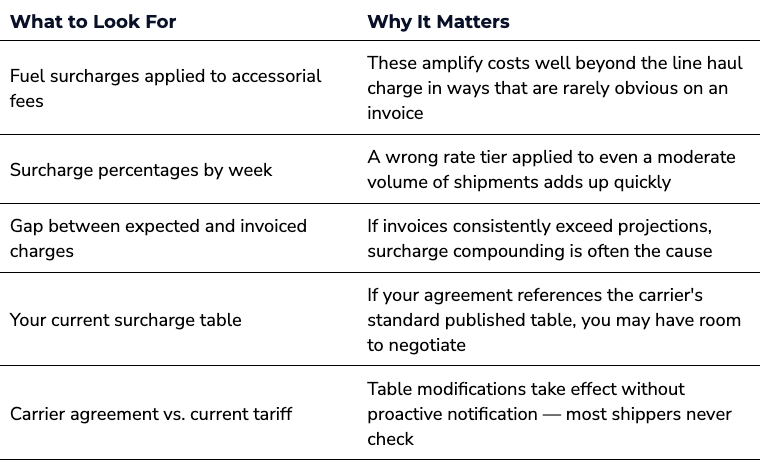
If you suspect fuel surcharges are inflating your freight invoices, the signals are usually visible in billing data —if you know where to look.
How TCI Helps Shippers Manage Fuel Surcharge Costs
TCI works with supply chain, logistics, and finance teams to bring clarity to how transportation spend is structured, billed, and managed, providing a full fuel surcharge picture across carriers, modes, and contract terms. This approach helps organizations understand where gaps exist, not just where individual charges appear high.
A Rapid Strategic Assessment
For organizations with $1M or more in annual freight spend, fuel surcharges are rarely the only issue. They are one piece of a broader transportation cost picture that includes contract structure, billing accuracy, and carrier relationships.
A Strategic Assessment evaluates the full transportation environment, including:
- Carrier and 3PL contracts, including the specific surcharge tables in effect and how they compare to published standards
- Rates, discounts, and whether fuel is being calculated on the gross or net rate
- How surcharges have been calculated across accessorial fees
- Invoice accuracy and billing outcomes across all carriers and modes, including any gaps between what was negotiated and what is being invoiced
- Operating practices that might affect total freight cost
- Negotiation opportunities based on shipment volume, mode, and lane profile
The outcome is clarity, followed by a prioritized roadmap — identifying where to focus first, what changes will have the greatest effect, and which issues require ongoing oversight.
The goal is to validate all charges, provide visibility, and help you manage or negotiate costs that should not be there in the first place.

Reference Sources
U.S. Fuel Price Data
- EIA Weekly On-Highway Diesel Prices — national and regional, updated weekly
- EIA Historical Diesel Price Data — weekly history dating back to 1994
- EIA Short-Term Energy Outlook — current forecast through 2027
Air Freight
- IATA Jet Fuel Price Monitor — average prices paid at the refinery for aviation jet fuel
- Ship & Bunker — bunker fuel prices by port and region
Carrier Surcharge Table Examples
Estes Express · XPO · Old Dominion · Saia · ABF Freight · R+L Carriers · UPS · FedEx